Trust Guard Security Scanned
hours left for
same day shipping

hours left for
same day shipping

Loading...

Spray Nozzle Installation

Spray nozzles will determine the spray pattern, distance, and flow rate of your sprinkler, so ensure that you’re selecting the right nozzle. When you’re ready to install your irrigation spray nozzles, start by turning off the water and removing the old nozzles. Next, screw the new nozzle clockwise onto the sprinkler head until snug. If using an adjustable spray nozzle, rotate the dial on top of the head to set the spray arc and adjust the flow control screw to adjust distance. Finally, turn on the sprinkler system to check for proper coverage and ensure there are no leaks.

How to Choose the Right Spray Nozzle

Picking the right sprinkler nozzle doesn't have to be complicated. The first thing that you’ll need to consider is the distance your water needs to travel. You want a nozzle that releases water just far enough to reach your plants and grass without wasting it on the sidewalk or driveway. Next, look at the shape of your yard to pick the best spray pattern. A 90-degree corner nozzle is better for tight spots, while a 180-degree half-circle is better for straight edges. Also consider water pressure and precipitation rate. If pressure is too high, misting and overspray can occur. If pressure is too low, your coverage may be uneven.

Spray head watering a beautiful lawn with verdant grass and vibrant flowers. Spray head watering a beautiful lawn with verdant grass and vibrant flowers.

Spray Nozzle FAQs

What is the difference between a spray nozzle and a rotary nozzle?

Spray nozzles emit a continuous fan-shaped spray across an area and are best for small to medium areas. On the other hand, rotary nozzles use multiple rotating streams of water and are more resistant to wind over a large area.

What do the colors of spray nozzles mean?

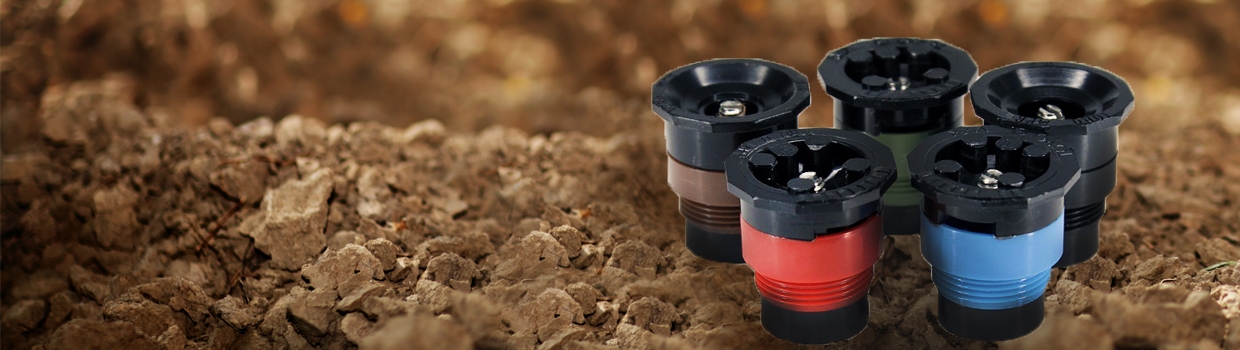
Nozzle colors typically indicate flow rate or spray angle, but the color coding varies by manufacturer. Before ordering lawn or garden spray nozzles, consider what kind of range you’ll need to cover with your sprinkler system. Depending on the watering area, it may be necessary to order a white spray nozzle rather than a red one.

How far do spray nozzles emit water?

The most common fixed spray nozzle distances include 4, 6, 8, 10, 12, and 15 feet. Adjustable spray nozzles can often be set within a range. If you need to cover distances greater than 15 feet, you may need to switch to a rotary nozzle or a larger rotor sprinkler head, which can easily shoot water out up to 50 feet or more.

How long should spray nozzles run?

Spray nozzles typically run for 10 to 15 minutes per watering cycle, depending on the plants and the soil. Because they apply water quickly, shorter cycles help prevent runoff and puddling. In hot or dry conditions, you may run them more frequently, while cooler seasons require less watering.

Why are my spray nozzles misting?

Spray nozzles usually mist when the water pressure is too high. Excess pressure breaks the spray into fine droplets instead of normal streams, causing water to drift and evaporate. Most spray nozzles work best at about 30 PSI. Installing pressure-regulated sprinkler heads or a pressure regulator can help stop misting and improve watering efficiency.

Can I mix different spray nozzles on the same sprinkler system?

You can mix different spray nozzles on the same sprinkler system as long as they have matched precipitation rates. You can usually mix different spray patterns, such as quarter-circle, half-circle, and full-circle nozzles, as long as they are sized for head-to-head coverage. Just avoid mixing standard spray nozzles with rotary nozzles in the same zone, as they apply water at different speeds.

How often should I replace my sprinkler spray nozzles?

Try to inspect your irrigation spray nozzles at least annually and replace them as needed. While there is no fixed lifespan, most nozzles last 5 to 10 years or more. If you start to notice uneven water distribution or generally low water pressure, it may be time for a new spray nozzle.