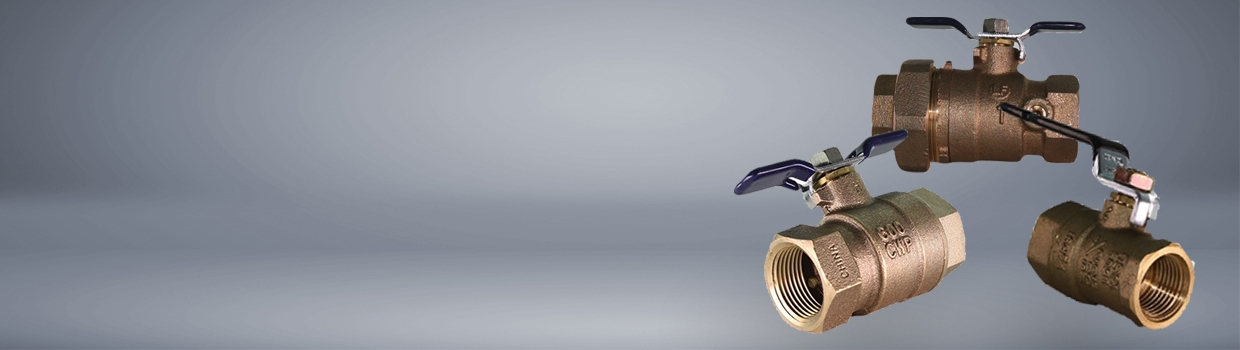
A ball valve is a type of shut-off valve that effectively controls the flow of water with a rotating ball mechanism. Ball valves are highly effective and are often repaired when they start to show signs of deterioration. At Sprinkler Warehouse, you can browse through several styles of replacement ball valves and explore a selection of replacement ball valve parts to keep your gear in top shape. Order ball valve handles, plugs, and full replacement ball valves from our website today.
Please re-enter quantity based on the required multiple
You are attempting to add items with a quantity which is not a multiple of the item's purchase quantity
Item # {partNumber} is sold in multiples of {minpackQty} {uom}
The quantity will be rounded up to {currQty} {uom} in your cart.
Do you want to proceed?
How Does a Ball Valve Work?
A ball valve controls the flow of liquid through a pipe by using a ball with a hole in it. The ball is mounted inside the valve body and can rotate 90 degrees to either open or close the flow path. When the valve handle is turned so that the ball's hole aligns with the pipe, fluid can flow freely through the valve. When the handle is turned 90 degrees, the ball rotates so that the hole is perpendicular to the pipeline, blocking the flow path. Ball valves provide an excellent seal when closed, as the ball is pressed tightly against the valve seats, ensuring minimal leakage. The design is particularly effective for high-pressure applications.
Ball Valve or Gate Valve?
Ball valves and gate valves are two types of valves used to stop or start the flow of water. A ball valve uses a rotating ball with a hole through the center to start or stop water flow, while a gate valve uses an internal gate that raises or lowers as the handle is turned. Ball valves are usually considered faster, as they can open or close completely with a simple 90-degree turn. Meanwhile, gate valves require multiple full turns of a round handwheel, which takes longer but helps prevent water hammer. These days, ball valves are often preferred for their quick shut-off capabilities, while gate valves may be found on older plumbing or mainline installations.
Replacement Ball Valve FAQs
What are the advantages of ball valves?
Ball valves are known for their easy operation and effective sealing. Ball valves typically require only a quarter-turn to open or close, making them quick and simple to operate. Ball valves also provide a tight seal when closed, ensuring minimal leakage over time.
How do you know if a ball valve is fully open or closed?
You can easily determine whether a ball valve is fully open or closed by checking the position of the valve handle. When the valve is fully open, the handle will be aligned with the pipe or flow direction. When the valve is fully closed, the handle will be perpendicular to the pipe.
Can ball valves be used as sprinkler shut-off valves?
Yes, ball valves are commonly installed on irrigation mainlines or before a sprinkler valve manifold to let you isolate part of the system for repairs. Ball valves are a great choice for a simple on/off function, but should not be used to regulate flow.
What types of pipe do ball valves connect to?
PVC ball valves are commonly used with PVC pipe and attach with slip and threaded connections. Brass ball valves often connect to threaded metal or PVC fittings, while poly ball valves may use insert/barbed ends with clamps for polyethylene pipe. Some irrigation systems also use compression or push-fit ball valves.
Can ball valves be used in high-pressure applications?
Yes. Not only can ball valves be used in high-pressure applications, but they are also well-suited for such conditions. Ball valves are made from strong materials like stainless steel and have strong sealing capabilities. Just make sure to choose a ball valve with a pressure rating suitable for your application.
Sign Up For Specials & Exclusive Discounts
Delivered directly to your inbox.
By inputting your email you agree to receive recurring promotional marketing emails from Sprinkler Warehouse.